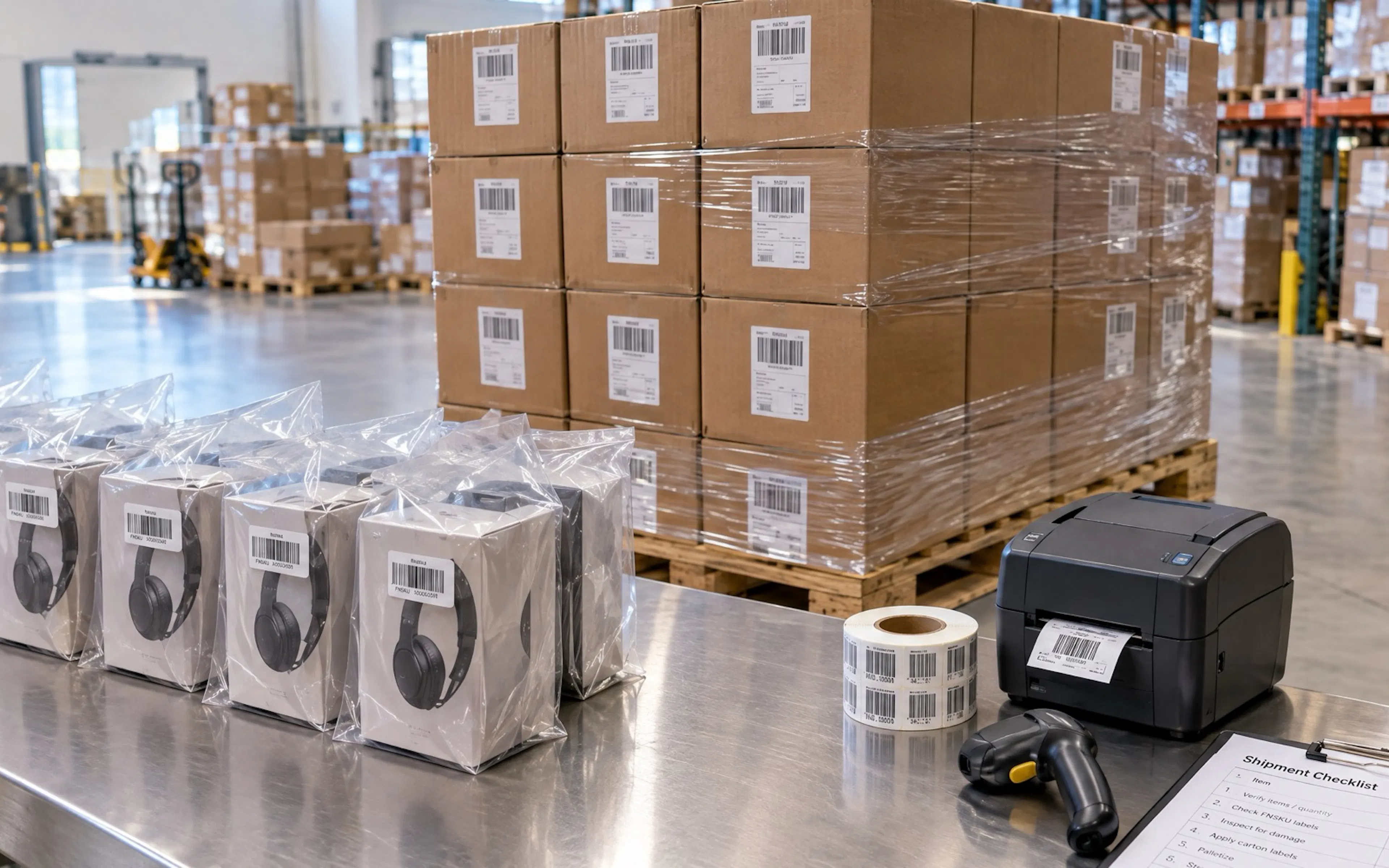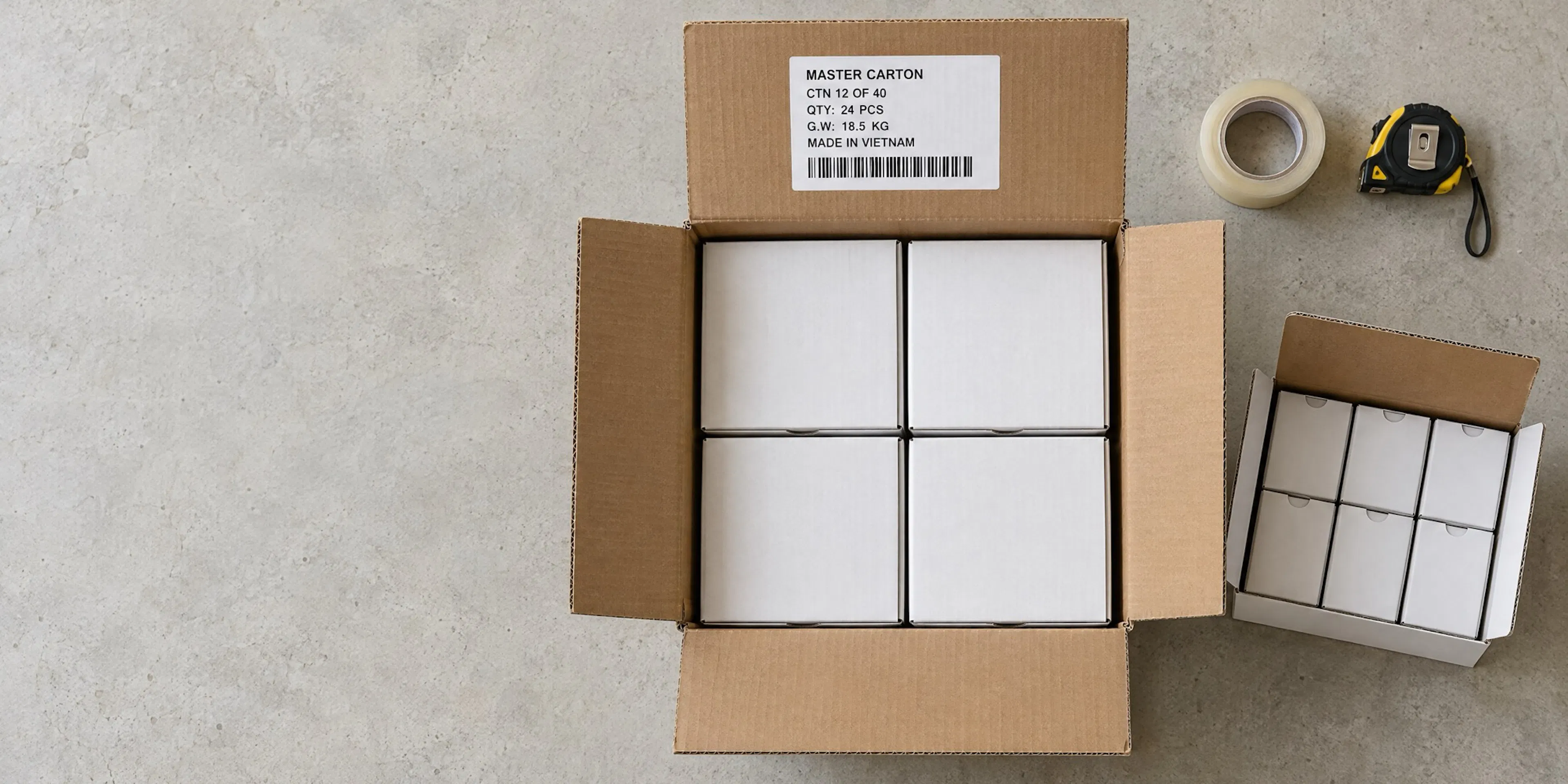
A master carton is the outer shipping box that holds a set number of units or smaller inner packs of the same product. It's the box your factory packs, the unit your freight forwarder counts, and the first thing a warehouse receives. A good master carton protects the product, carries clear markings, and fits the carton and pallet rules of wherever your inventory goes next.
This guide explains how master cartons relate to inner packs, case packs, and pallets, what to print on them, the Amazon FBA and Walmart WFS carton rules, and how a 3PL handles master cartons that don't arrive ready for a marketplace.
The packaging hierarchy
Products move through the supply chain in layers. Each layer has a name, and the names are often used loosely:
Level | What it is | Example |
|---|---|---|
Unit (each) | The single sellable item, usually in its retail box | One water bottle |
Inner pack (inner carton) | A small carton grouping a few units inside the master carton | 6 bottles |
Case pack | A box of identical units in a fixed quantity, ready to receive as-is | 24 bottles |
Master carton (master case) | The outer shipping carton holding units or inner packs | 4 inner packs = 24 bottles |
Pallet | Master cartons stacked and wrapped on a pallet | 24 cartons = 576 bottles |
In many supply chains, the master carton and the case pack are the same box: one carton of 24 identical units. The terms only separate when a large outer carton holds several smaller cases, or when a marketplace sets its own definition.
Master carton vs inner carton
The inner carton keeps small or fragile units organized and protected, and it is often the quantity a retailer or wholesaler orders. The master carton is the transport box: it's built for stacking, handling, and freight. If you sell in packs of 6 to wholesale buyers and ship single units to consumers, inner cartons of 6 save repacking time at the warehouse.
Master carton vs case pack
"Case pack" describes how the units are packed: identical SKUs in the same quantity in every box. "Master carton" describes which box it is: the outermost carton. Amazon uses "case-packed" as a shipment type (see below), so the difference matters when you send to FBA.
What to print on a master carton
Master carton markings, also called shipping marks, let anyone in the chain identify the carton without opening it. Your supplier prints them on at least two sides, and many buyers require all four:
Marking | Why it matters |
|---|---|
Brand or consignee name | Identifies the owner at the port and the warehouse |
PO number | Links the carton to the purchase order |
SKU and product description | Lets receiving count by SKU |
Quantity per carton | Units (and inner packs) inside |
Carton number, "12 of 40" | Shows whether the full shipment arrived |
Gross and net weight | For handling, freight, and carrier rules |
Carton dimensions | For freight quotes and storage planning |
Country of origin, "Made in Vietnam" | Customs marking and buyer requirements |
Barcode (UPC, EAN, or GTIN-14 case code) | Lets the warehouse scan cartons at receiving |
Handling marks | "This side up," "Fragile," "Team Lift" for heavy cartons |
Country of origin marking
U.S. customs rules in 19 CFR Part 134 require imported articles, or their containers, to be marked with the English name of the country of origin, legibly and permanently, for the "ultimate purchaser." In most cases that means the product or its retail box, not the master carton. The master carton itself has to be marked when it's the container the article ordinarily reaches the ultimate purchaser in, or when the article is excepted from marking. Buyers and customs brokers usually ask for "Made in country]" on master cartons anyway, so include it. See our [importer of record guide.
Master carton dimensions and weight
There's no standard master carton size. Your factory chooses it based on the product, the pallet, and the container. Three limits usually decide it:
- Weight. Keep cartons under about 50 lb (23 kg) so one person can lift them. Amazon and Walmart both build their rules around 50 lb.
- Pallet fit. A U.S. pallet is 40 × 48 inches. Cartons that tile the footprint without overhang stack safely and waste less space. Plan it with the pallet planner.
- Volume. Freight from Asia is priced by cubic meter, so check carton CBM with the CBM per carton calculator.
Box strength: ECT vs Mullen
Corrugated boxes are rated two ways. Edge Crush Test (ECT) measures stacking strength, and Mullen (burst) measures how much pressure the board takes before it ruptures. Freight classification rules (NMFC Item 222 and UFC Rule 41) accept either rating. Single-wall 32 ECT is commonly treated as the equivalent of 200 lb Mullen board and is the usual minimum for master cartons that will be stacked on pallets. For drop and vibration testing, ISTA publishes test procedures, including the 3A procedure for parcel packages and a member procedure for products shipped to Amazon in their own container.
Amazon FBA carton requirements
When you create a shipment in Send to Amazon, you choose how units are packed:
- Individual units: a box can hold different SKUs. You must give box content information for every box.
- Case-packed: every box holds the same SKU, in the same condition, in the same quantity. You enter the case-pack template once: units per box, box weight, and box dimensions.
Rules to plan master cartons around:
Rule | Requirement |
|---|---|
Maximum box size (FBA, U.S.) | 36 × 25 × 25 inches, since June 20, 2025 (it was 25 inches on every side). Exceptions apply for a single oversize item. |
Maximum box size (AWD) | 25 inches on every side |
Maximum box weight | 50 lb, unless the box holds a single item that weighs more |
Labels | A carrier label and an FBA box ID label on every box, on a flat side, not over a seam or corner |
Pallets | An FBA pallet label on each of the four sides |
A factory master carton often doesn't qualify as an Amazon case pack. A master carton that holds several inner packs, or more than one SKU, must be broken down to the case-pack level or shipped as individual units. Each unit still needs its prep and an FNSKU label unless it qualifies for manufacturer barcode tracking. Amazon updates these limits, so confirm them in Seller Central before you finalize carton specs with your factory.
If you're deciding between FBA, AWD, and a 3PL for reserve stock, see best 3PL for Amazon sellers.
Walmart WFS case requirements
Walmart Fulfillment Services publishes its own case rules:
- A case can weigh up to 150 lb, but Walmart recommends 50 lb and 31.5 × 23.25 × 16 inches as the maximum master case size.
- Cases should be regular slotted cartons (RSC) in B-flute board rated 32 ECT or 200 lb burst.
- Displays, gaylords, banded or taped bundles, and reused boxes with old labels aren't accepted.
- Every case needs a WFS receiving label. Single items over 50 lb need "Team Lift" labels, and over 100 lb need "Mech Lift" labels.
Non-compliant cases can be refused and returned, and fees may apply. See Walmart Fulfillment Services.
A worked example
A supplier ships 40 master cartons, each holding 4 inner cartons of 6 units (24 units per carton). Each master carton measures 20 × 16 × 12 inches and weighs 40.8 lb (18.5 kg).
Question | Calculation | Result |
|---|---|---|
Total units | 40 × 24 | 960 units |
Volume per carton | 20 × 16 × 12 = 3,840 in³ | 0.063 CBM |
Total volume | 40 × 0.063 | 2.52 CBM |
Cartons per pallet layer | (48 ÷ 16) × (40 ÷ 20) | 6 per layer |
Pallets needed (4 layers, about 53 inches tall) | 40 ÷ 24 | 2 pallets |
Parcel billable weight per carton (divisor 139) | 3,840 ÷ 139 = 27.6 lb vs 40.8 lb actual | 41 lb (actual weight) |
FBA as case-packed? | 24 identical units, under 50 lb, within 36 × 25 × 25 in | Yes, if the inner cartons aren't separate sellable units |
Check your own numbers with the dimensional weight calculator and the freight class calculator.
How a 3PL handles master cartons
At ShipHouse, master cartons are the starting point for most inbound work:
- Receiving: cartons are counted against the packing list, carton numbers are checked ("x of y"), and shortages or damage are reported. Standard receiving is free within a 4-labor-hour allowance per shipment. See the receiving cost calculator.
- Storage: full master cartons go into pallet storage as reserve stock, which keeps them sealed until they're needed.
- Breakdown: cartons are opened to pick consumer orders or to build the case packs a marketplace requires. See pick and pack.
- Prep and relabeling: units get FNSKU labels and bags, and cartons get new box ID and carrier labels. See FBA prep.
- Re-casing and kitting: units are re-cased into compliant cartons or built into bundles. See kitting.
- Palletizing: cartons are stacked and labeled for FBA, WFS, or retail delivery. At published starter rates, palletization is $30 per pallet plus $1 per carton, so the example above costs 2 × $30 + 40 × $1 = $100. See pricing.
For wholesale buyers who order by the case, master cartons can often ship as they arrived. See B2B and wholesale fulfillment.
Frequently asked questions
What is a master carton?
The outer shipping carton that holds a fixed number of units or inner packs of a product. It's the box factories pack, freight carriers move, and warehouses receive.
What is the difference between a master carton and an inner carton?
An inner carton groups a few units inside the master carton. The master carton is the outer transport box that holds the inner cartons.
Is a master carton the same as a case pack?
Often, but not always. A case pack is a box of identical units in a fixed quantity. A master carton is the outermost box, which can hold loose units or several smaller case packs.
What is a master case?
Another name for a master carton, common in retail and Walmart's requirements.
What should be printed on a master carton?
The brand or consignee, PO number, SKU, quantity, carton number ("x of y"), gross and net weight, dimensions, country of origin, a barcode, and handling marks.
What is the maximum master carton size for Amazon FBA?
For U.S. FBA shipments, boxes can be up to 36 × 25 × 25 inches and 50 lb, unless they hold a single oversize item. Amazon Warehousing and Distribution (AWD) keeps the 25-inch limit.
Can I send master cartons straight to Amazon?
Only if each carton meets Amazon's box limits and qualifies as a case pack, or if you ship it as individual units with box content information. Units still need their prep and labels.
What box strength should a master carton have?
Single-wall 32 ECT, or the equivalent 200 lb Mullen board, is a common minimum. Walmart WFS accepts both. Heavy or fragile products may need double-wall board.
Do master cartons need a country of origin marking?
U.S. rules require the product or the container it reaches the buyer in to show the country of origin. Buyers and customs brokers usually also want "Made in [country]" on master cartons, so it's best to include it.
The bottom line
The master carton is where your supply chain starts. Get its size, strength, and markings right at the factory, and receiving, storage, and marketplace prep all go faster. Get it wrong, and someone has to open, relabel, or re-case every carton before it can sell.
If your master cartons need breakdown, prep, or re-casing for Amazon, Walmart, or wholesale, tell us about your products.
Requirements in this guide come from Amazon's seller documentation and seller forum updates, Walmart Marketplace Learn, 19 CFR Part 134, and ISTA, current as of November 2026. Marketplace carton rules change often, so check the latest versions before finalizing carton specs.