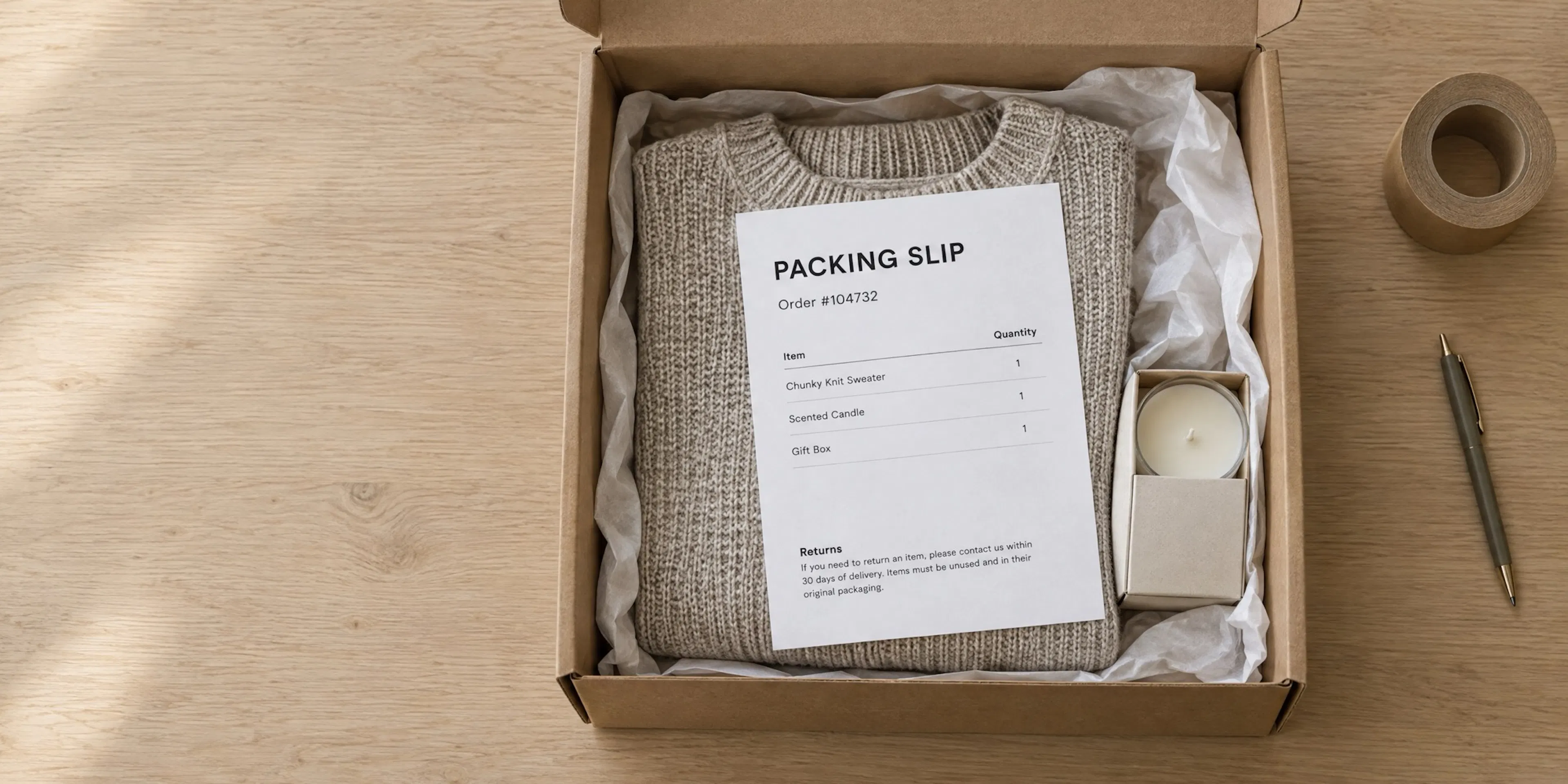
A packing slip is the document inside a shipment that lists what's in the box: the order number, the items, and the quantities shipped. It helps the customer check the order and start a return, and it helps the warehouse confirm the right items went into the right box. It usually doesn't show prices, and it isn't a customs or carrier document.
This guide covers what to put on a packing slip, how it differs from an invoice, packing list, and bill of lading, what Amazon, Walmart, and other marketplaces require, and how a 3PL handles packing slips at scale.
What a packing slip is for
A packing slip does three jobs:
- For the customer: it confirms what's in the box, flags anything back-ordered or shipped separately, and explains how to return items.
- For the warehouse: it's the checklist the packer compares against the picked items before sealing the box.
- For returns: the order number on the slip links a returned item back to the original order.
What to include on a packing slip
Field | Ecommerce orders | B2B and wholesale orders |
|---|---|---|
Order number | ✓ | Purchase order (PO) number |
Order date | ✓ | ✓ |
Ship-to name and address | ✓ | Store or distribution center address |
Your business name and contact details | ✓ | ✓ |
SKU and item description | ✓ | Plus the retailer's item number |
Quantity ordered vs quantity shipped | ✓ | ✓ |
Back-ordered or separately shipped items | If any | If any |
Carton count and contents | — | Usually required by the retailer |
Return instructions | ✓ | Per the retailer's terms |
Prices | Optional (usually left off) | Usually left off |
A simple packing slip template
Item | SKU | Description | Qty ordered | Qty shipped |
|---|---|---|---|---|
1 | TS-001 | Cotton T-shirt, black, M | 2 | 2 |
2 | HD-004 | Hoodie, gray, L | 1 | 1 |
3 | WB-010 | Water bottle, 24 oz | 1 | 0 (ships separately) |
Above the table, add your logo, the order number and date, and the ship-to address. Below it, add a short note with return instructions and a way to contact you.
Gift orders
For gift orders, leave prices off the slip, include the buyer's gift message, and keep return instructions so the recipient can exchange the item. Marketplaces such as Amazon offer gift options that hide prices on the packing slip. On Shopify, you can hide prices by customizing the packing slip template.
Packing slip vs packing list vs invoice vs bill of lading
These four documents are often confused, but they have different jobs and different legal weight:
Packing slip | Packing list | Commercial invoice | Bill of lading (BOL) | |
|---|---|---|---|---|
Purpose | Tells the customer what's in the box | Details the contents of each carton or package in a shipment | Records the sale for payment and customs | Carrier's receipt and contract to move the freight |
Who uses it | Customer, warehouse | Receiver, customs, carrier | Buyer, customs | Shipper, carrier, receiver |
Shows prices? | Usually not | Usually not | Yes | No |
Legally required? | No | For imports, CBP needs per-package contents, on the invoice or a packing list | Yes, for U.S. imports | Yes, for for-hire truck freight |
Typical shipment | Parcel orders | International and B2B shipments | International and B2B shipments | Pallets and truckloads |
Two rules make the difference clear:
- For U.S. imports, the commercial invoice is the customs document. CBP requires a commercial invoice for each shipment, and each invoice must state in adequate detail what's in each individual package. That's often done with a separate packing list. A consumer packing slip doesn't meet this requirement. See our importer of record guide.
- For truck freight, the bill of lading is the carrier's document. For-hire motor carriers must issue a receipt or bill of lading showing the shipper, receiver, number of packages, description of the freight, and weight. The packing slip has no role in that contract.
Packing slip rules by marketplace
Channel | What matters |
|---|---|
Amazon (seller-fulfilled) | Under Amazon's Drop Shipping Policy, you must be the seller of record and identify yourself as the seller on all packing slips, invoices, and packaging. Slips or packaging naming another seller or supplier are prohibited. See FBA vs FBM. |
Walmart Marketplace | Packages may not name any entity other than the manufacturer or seller on the packing slip, materials, invoice, or packaging, and you may not ship in competitor boxes. See Walmart Fulfillment Services. |
Shopify | Packing slips list the items and the shipping and billing addresses. You can edit the template and print slips in bulk from the orders list. See Shopify fulfillment. |
eBay | You can print a packing slip for one order or several from Seller Hub, using "Print packing slip and more." See eBay fulfillment. |
TikTok Shop | You can print a packing list for orders from Seller Center. See TikTok Shop fulfillment. |
The common thread: the slip must carry your brand, not your supplier's or your warehouse's. That's one reason a 3PL's packing slips should be built from your template. It also matters if you're moving from dropshipping to your own inventory; see dropshipping vs 3PL.
Packing lists for B2B and retail orders
Retailers set their own document rules in routing guides. They typically require a packing list for each purchase order, attached to the lead carton or to every carton, with carton-level contents by style, size, and color. Missing or incorrect paperwork can lead to chargebacks, so always check the retailer's current guide before shipping. See B2B and wholesale fulfillment.
Where does the packing slip go?
For parcels, the packing slip goes inside the box, on top of the items so the customer sees it first. For pallet and carton shipments, retailers often want the packing list in a clear "packing list enclosed" pouch on the outside of the lead carton. Follow the routing guide when there is one.
How a 3PL handles packing slips
At a 3PL, packing slips are generated automatically:
- Order sync: the order comes in from your store or marketplace with items, quantities, and shipping details.
- Your template: the slip is printed from a template with your logo, return instructions, and gift settings.
- Pack verification: the packer scans each item against the order before the slip goes into the box.
- Inserts and kits: branded inserts, thank-you cards, or kit components are added according to your rules. See kitting.
- Returns: the order number on the slip lets returns be matched to the original order. See reverse logistics.
ShipHouse includes packing slips in its pick and pack workflow, with published starter rates from $2.50 per order. See pick and pack.
Frequently asked questions
What is a packing slip?
A document included in a shipment that lists the order number and the items and quantities in the box. It helps the customer check the order and the warehouse confirm it was packed correctly.
Is a packing slip the same as an invoice?
No. An invoice records the sale and shows prices for payment. A packing slip lists what's in the box and usually doesn't show prices.
What is the difference between a packing slip and a packing list?
A packing slip is usually for the end customer of a parcel order. A packing list details the contents of each carton in a larger shipment and is used by receivers, carriers, and customs.
What is the difference between a bill of lading and a packing slip?
A bill of lading is the carrier's receipt and contract for moving freight. A packing slip is an informational document for the customer and has no role in the carrier contract.
Do I legally need a packing slip?
Not for most domestic ecommerce orders. Marketplaces and retailers may require one, and imports need a commercial invoice that details each package's contents.
Does a packing slip show prices?
Usually not. Prices are optional, and gift orders should leave them off.
What does Amazon require on packing slips for seller-fulfilled orders?
You must be the seller of record and identify yourself as the seller on packing slips, invoices, and packaging. Slips naming a third-party supplier are prohibited.
Can a 3PL use my branding on packing slips?
Yes. A 3PL prints packing slips from your template, with your logo, contact details, and return instructions.
Do I need a packing list for international shipments?
For U.S. imports, CBP requires a commercial invoice that states what's in each package, often supported by a packing list.
Where does the packing slip go?
Inside the box, on top of the items, for parcel orders. For B2B shipments, follow the retailer's routing guide, which often calls for a packing list on the lead carton.
The bottom line
A packing slip is a simple document, but it does real work: it confirms the order for the customer, guides the packer, and connects returns to the original order. Keep it branded as your own, follow each marketplace's rules, and don't confuse it with the invoices, packing lists, and bills of lading that customs and carriers require.
If you want packing slips and branded inserts handled for every order, tell us about your products and channels.
Rules in this guide come from U.S. federal regulations (19 CFR Part 141 and 49 CFR 373.101) and the published policies of Amazon, Walmart, Shopify, and eBay, current as of November 2026. Marketplace and retailer requirements change, so check the latest versions before shipping.